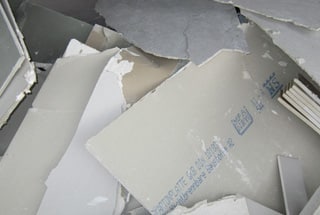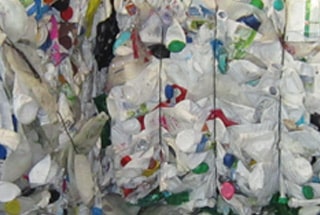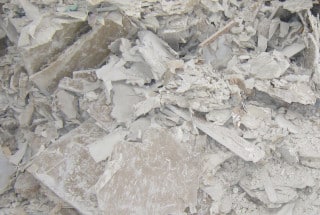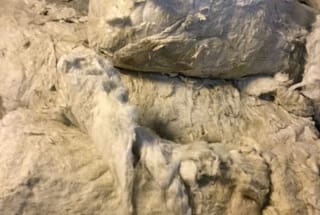
Cement sheeting reaches a container’s volumetric limit long before it reaches the weight limit. That means paying industrial waste rates to move air, and the cost sits in haulage rather than in the gate fee most people quote.
Ask a contractor what cement sheeting costs to remove and you get a figure per tonne. Look at the invoices after the job and the gate fee is a minority of the total.
Why the container fills first
Corrugated sheeting has a geometry problem. The profile that gives the board its structural performance on a roof is the same profile that stops it nesting in a container. Sheets sit with corrugations crossing, and the void between them is dead space you are paying to transport.
Flat panels theoretically stack better. In practice they arrive broken, at random sizes, with fixings attached, and they do not stack either.
The result is a container at its volumetric limit and a fraction of its permitted payload — then a call for the next one.
Three costs that volume drives
Haulage. Every container movement carries the same fixed cost regardless of load: driver hours, fuel, vehicle time, site access slot. A vehicle at 40% of weight capacity costs the same to run as a full one. When volume is the binding constraint, you pay full price to move less.
Container hire and turns. More movements means more containers standing on site, more crane or telehandler time loading them, more traffic management, and more supervisor hours spent on logistics rather than production. On constrained urban sites, container space is sometimes the actual limit on programme speed.
Landfill void. This is the cost that gets overlooked, because it is invisible on a per-tonne invoice. Landfill is consumed by volume, not by mass. A cell filled with corrugated sheeting is filled largely with air, and that void is gone permanently. For hazardous waste, where permitted capacity is finite and getting harder to replace, void is the scarce resource — and the price reflects it.
On site: the asbestos-free fraction is where the saving is
Asbestos-containing sheets leave the demolition site intact and wrapped. Breaking them in the open is the thing that must not happen, so the transport inefficiency on that stream is the price of handling it correctly. It is not something to engineer away at source.
The asbestos-free fibre cement is a different matter entirely, and most sites do not act on it — usually because nobody has put a number on it. That material can be size-reduced at source with appropriate dust control, which cuts container movements before anything moves at all.
Which is why the identification work comes first and pays for itself several times over. See eternit, asbestos cement or fibre cement?
At a licensed facility: the same arithmetic, larger numbers
This is the part that rarely gets discussed, and it is where the economics are sharpest.
A licensed reception or treatment facility takes in asbestos cement sheeting exactly as it left the site: whole, wrapped, and mostly air. Every subsequent cost the facility carries is driven by that volume — storage footprint, internal handling, and above all the landfill void consumed per tonne received.
Inside a licensed facility, size reduction is available. The material is already inside containment, already under negative pressure, already handled by licensed operators with the monitoring and documentation that the regime requires. Reducing the volume there is not a regulatory question — it is an equipment question.
What it changes:
- Landfill void consumed per tonne falls, which extends the life of permitted capacity that cannot easily be replaced
- Internal handling and storage get cheaper, because the same throughput occupies less floor
- Onward transport, where material moves between facilities or to a treatment process, costs less per tonne for the same reason it does on a demolition site
- Feed to a treatment process becomes consistent. Thermal and chemical treatment routes need a prepared, size-controlled feed — whole sheets are not a feedstock. See what fibre cement waste must look like to have a value
The constraint is the machine. Most size-reduction equipment is unsuitable for installation inside a containment system, for reasons that are mechanical rather than regulatory — which is the subject of impact or force: choosing equipment for fibre-reinforced board.
Landfill is getting more expensive
Across European markets the cost of landfilling construction and hazardous waste is moving in one direction, through several instruments at once:
- Landfill taxes and levies are rising, and the rates applied to inert and low-impact waste are rising proportionally faster than the headline hazardous rates. The policy signal is explicit: landfilling material that could be recovered is no longer supposed to be cheap
- Landfill bans on specific recoverable fractions are expanding
- Permit conditions increasingly require operators to demonstrate a recovery route before accepting material
- Capacity is finite, particularly for hazardous waste, and gate fees follow the scarcity
- Reporting obligations make landfilled tonnage visible in a way it was not a decade ago
A disposal model built on the assumption that capacity stays cheap has a limited shelf life. Rates differ by country and change annually, so the number to plan against is not today’s figure — it is the trajectory.
Building the number
Most operations hold four of these five inputs and have never assembled them in one place.
| Input | Source |
|---|---|
| Quantity of material by stream, in tonnes and m² | Survey take-off split by construction phase, or facility intake records |
| Loose bulk density as received | Weigh a container. Handbook figures are useless here — the variance is enormous |
| Container volume and permitted payload | Waste contractor’s fleet specification |
| All-in cost per container movement, and cost per m³ of landfill void | Haulage invoice and disposal contract, not the quoted gate fee alone |
| Round trip distance and daily movement capacity | Programme, or facility throughput |
Two figures come out: how many movements the operation actually requires, and what proportion of each movement, and each cubic metre of void, is air.
Run the same calculation against a reduced-volume fraction and compare. That comparison, with your own numbers, is the version that gets signed off — and it is also the version that will tell you honestly if the volumes do not justify processing. Better to know before anyone specifies a machine.
The emissions line is now a reporting line
Transport reduction used to be a paragraph in a tender document. Under current corporate reporting regimes it is a figure somebody has to report, and transport emissions from waste movements are among the easier items to quantify honestly.
Fewer movements is a reduction evidenced by haulage records rather than estimated with a coefficient. For contractors bidding work where the client carries a reporting obligation of their own, that distinction is worth something at tender stage.
Volume reduction done badly, and done properly
The obvious approach is a fast shredder. That gets the volume down and creates three new problems: airborne dust from a fibre-reinforced mineral board, a large fines fraction that downstream receivers reject, and every nail, screw and bracket driven into the material rather than released from it. Inside a containment system it creates a fourth: an airflow the containment then has to fight.
Controlled reduction is a different operation, and it is what ACA machines are built for — on both streams:
Low speed, high torque. 15 RPM with up to 13,000 Nm of torque per shaft. The board is broken by force rather than impact, which means no machine-generated airflow and substantially less fine material.
Fixings released, not embedded, so a downstream magnet has something to remove.
A consistent output fraction rather than mixed rubble — which is what allows the material to be specified, whether the receiver is a cement producer or a treatment process.
Electric drive. 100% electric, 75 dB at one metre when running empty, and without exhaust.
Continuous operation with automatic reverse on overload and independently driven shafts, so an unexpected bracket stalls one zone and clears itself rather than stopping the shift.
Hopper capacities from 2 to 20 m³, matched to the feed rate the operation actually delivers.
For asbestos-containing material the machine is installed inside the customer’s licensed containment and operated under the applicable regime. The machine is built for that environment; the permission comes from the facility’s licence, not from the equipment. No machine makes asbestos safe — what it does is reduce the material inside a system built to contain it.
Frequently asked
Why is cement sheeting expensive to dispose of?
Because cost follows volume rather than weight. Corrugated sheeting fills a container’s volumetric capacity at a fraction of its permitted payload, so haulage cost per tonne is far higher than for dense materials — and landfill void, which is consumed by volume, is largely filled with air.
Can asbestos cement waste be volume-reduced?
Yes, at a licensed facility, inside containment under negative pressure with appropriate filtration and under the applicable asbestos regime. It is not done in the open on a demolition site, where sheets must leave intact and wrapped.
Can fibre cement waste be crushed on site?
Asbestos-free fibre cement can be size-reduced at source with appropriate equipment and dust control.
How much volume reduction is achievable?
It depends on the board type, profile and how the material arrives. The only reliable answer comes from running your own material, which is why we offer test runs rather than quoting a ratio.
Find out what your volume is costing you
Send us your tonnages, container specification and a sample. We will process the material, describe the output fraction, and give you the comparison in your own numbers — for a site, a reception facility, or both.
Book a test run · +45 24 82 25 82 · info@acaindustry.com