Case: Eliminate the disposal costs from gypsum offcuts by processing the material on-site
What this case is about
How a plasterboard manufacturer uses an ACA crusher to crush production offcuts and faulty boards on-site, separating clean gypsum from paper so it can be fed directly back into new board production – with zero gypsum going to landfill.
Who is this case mainly for?
Plasterboard and gypsum board manufacturers generating production waste, offcuts or rejects – and recycling operators handling gypsum-containing waste from construction or demolition.
What can you gain from reading the case?
A concrete understanding of how on-site crushing eliminates disposal costs, reduces transport volume, recovers a high-value raw material and enables continuous recycling without contaminating the gypsum fraction.
Turning production waste into production input
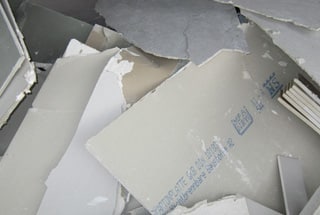
In a plasterboard manufacturing facility, not everything that comes off the line is sellable. Boards get rejected for dimensional faults, surface defects, or simply as offcuts from the cutting process. What was raw material one hour ago becomes waste the next.
For years, the standard approach has been to load that waste onto trucks and send it off for disposal. It works – but it is expensive, resource-intensive and increasingly difficult to justify as material costs rise and landfill restrictions tighten across Europe.
There is a better option, and it starts with recognising that gypsum board waste is not actually waste. It is raw material in the wrong form.
The challenge: separating gypsum from paper without contamination
Plasterboard is gypsum sandwiched between two layers of paper or fibre facing. The recycling opportunity is clear – crush the board and recover the gypsum. But the challenge is that standard shredding or crushing equipment tends to blend the paper fibres into the gypsum, contaminating the output and making it unsuitable for re-entry into board production.
If the gypsum fraction contains too much paper, it cannot be reused. The result is a poor-quality mixed waste that ends up in disposal rather than recycling – which defeats the purpose entirely. For gypsum recycling to work, the separation has to be clean.
Send us an e-mail and we will tell you what makes our crushers so unique!
How the ACA crusher handles it
The ACA crusher for plasterboard operates at just 15 RPM with a torque of 13,000 newton metres. That combination of low speed and high force is what makes the difference. Rather than shredding the material aggressively, the machine works methodically – breaking the boards apart in a way that separates the gypsum from the paper facing rather than blending them together.
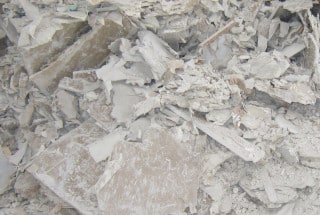
The result is three clean fractions: gypsum, paper and any metal components. Each can be handled separately. The gypsum fraction is pure enough to go directly back into new plasterboard production. The paper can be sent for paper recycling or to a waste-to-energy facility, where it contributes to CO2-neutral electricity and heat production. Nothing is wasted.
The machine can be fitted with a large hopper that accommodates loading by conveyor belt or digger, and the output size is adjustable. The configuration – available with 2, 4, 6, 8 or 10 screws depending on throughput requirements – means the machine scales to the production volume, not the other way around.
It is built for 24/7 operation, with a reverse function that protects the machine against overload. The weight of the unit – between 5 and 20 tonnes – reflects its durability rather than its energy appetite. Because the moving parts never contact each other directly, wear is minimal and maintenance intervals are long.
What it means in practice
The economic case is straightforward. Every tonne of gypsum recovered on-site is a tonne that does not need to be transported for disposal – and a tonne of raw material that does not need to be purchased. In a facility generating significant volumes of production offcuts, that adds up quickly.
Volume reduction from crushing also means fewer truck movements for any remaining waste streams, which directly reduces transport costs and the associated CO2 emissions. The same logic that ACA applies across all materials applies here: if you can double the fill rate of a truck, you halve the number of trips. For a facility running continuous production, that is a measurable operational and environmental gain.
The closed-loop outcome is what makes this particularly relevant for manufacturers working toward circular production commitments or under pressure to improve recycling documentation for ESG reporting. Rather than reporting gypsum waste as a disposal cost, it becomes a recovered input.
Why it works for waste processors too
The same machine logic applies to recycling operators handling construction or demolition waste containing plasterboard. Renovation sites, demolition projects and construction build-outs all generate gypsum board waste in significant volumes. An operator equipped with an ACA crusher can receive that material, process it on-site, and produce a saleable gypsum fraction rather than a disposal problem.
That shift – from waste handler to material recovery operator – is precisely what makes the economics work at both ends of the chain.
How ACA approaches this
ACA configures the machine to the customer’s material, throughput and site conditions. For plasterboard applications, the focus is on maintaining gypsum purity throughout the crushing process, producing an output that is genuinely useful rather than merely reduced in volume. Contact ACA to discuss your specific setup and material volumes.
Support 24/7
We provide support 24/7, so we are always easy to get hold of. Don't hesitate to call us if you have a problem. We'll find a solution to your problem, so you can move on.
Would you like us to give you a call?