Fibre cement and asbestos cement waste
The three terms
Eternit, asbestos cement and fibre cement describe boards that look the same, come off the same buildings, and are handled under completely different regimes. Getting the distinction right is the first processing decision on any large demolition or refurbishment project, and it determines every decision after it.
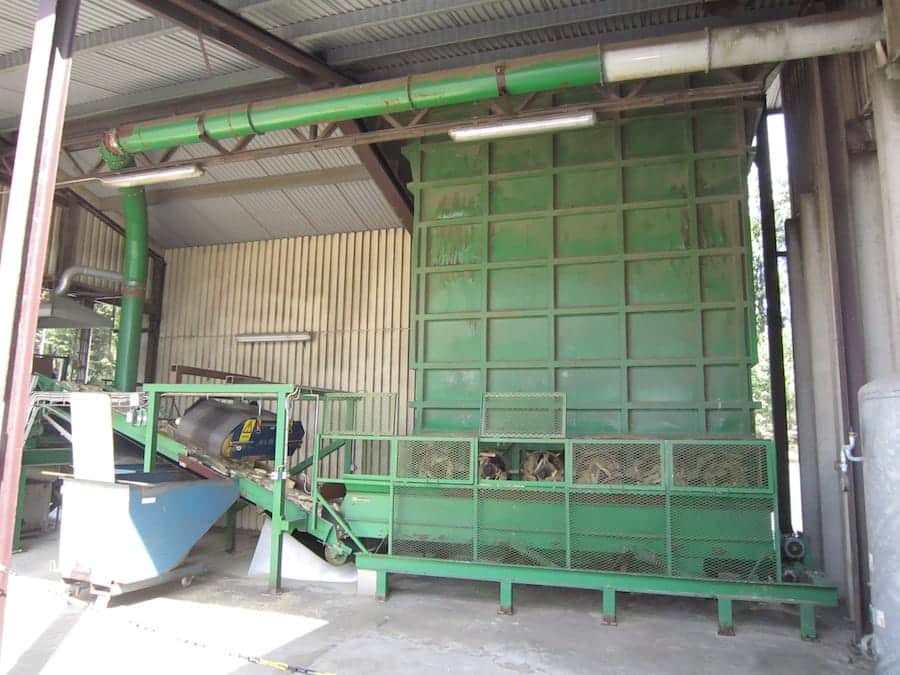
The biomass output from our crushers is as pure as it gets
| Term | What it means | Waste status |
|---|---|---|
| Eternit | A brand name, used generically across Northern Europe for corrugated and flat cement sheeting. Describes a format, not a composition | Tells you nothing on its own |
| Asbestos cement (AC) | Cement sheeting made before the asbestos ban, reinforced with asbestos fibre. Also called AC sheeting, bonded asbestos, or transite in North America | Hazardous waste. Licensed removal and licensed processing |
| Fibre cement | The same product made after the ban, reinforced with cellulose and PVA fibres. Written fiber cement in American English | Ordinary construction waste, with a recovery route |
| ACM | Asbestos-containing materials — the regulatory umbrella covering AC sheeting, insulating board, pipe lagging and related products | Governed by the asbestos regime in each jurisdiction |
Where the material arises
Cement sheeting is not only a roofing question. On industrial and institutional sites it appears as:
- Corrugated roofing and wall cladding on factories, warehouses, agricultural buildings and depots
- Flat facade panels and rainscreen cladding on schools, hospitals, housing blocks and offices
- Soffits, eaves boards, partition panels and ceiling boards
- Pressure pipe in water distribution, plus flue pipes, ducting and cable conduit
- Fire-protective linings and boarding around plant and risers
The holders are not only construction companies. Utilities, process industry, energy companies and facility management teams carry substantial quantities that have never been counted in one place.
We process both streams
Most suppliers of size-reduction equipment will quote for asbestos-free fibre cement and decline asbestos-containing material outright. We do not.
ACA crushers are built for both. What differs is not the machine’s ability to handle the material — it is where the machine is installed and who holds the licence.
Asbestos-free fibre cement can be processed on site or at a reception facility, with appropriate dust control. The commercial case is disposal and haulage cost avoided, plus access to a recovery route into cement production.
Asbestos-containing material is processed inside a licensed facility: the machine is installed within the customer’s containment — enclosure, negative pressure, pre-filtration and HEPA-grade final filtration — and operated under the asbestos regime in that jurisdiction. The machine is designed for that environment. The permission to process the material comes from the facility’s licence, not from the equipment.
That distinction matters and we state it plainly. No machine makes asbestos safe. The fibre is destroyed or contained, and a crusher does neither. What a crusher does is reduce the material inside a system built to contain it — which is a real and specific job, and one that a great deal of equipment on the market is unsuitable for.
Call us now and let us tell you why our bale opener and crushers are unique!
Why low speed is what makes this possible
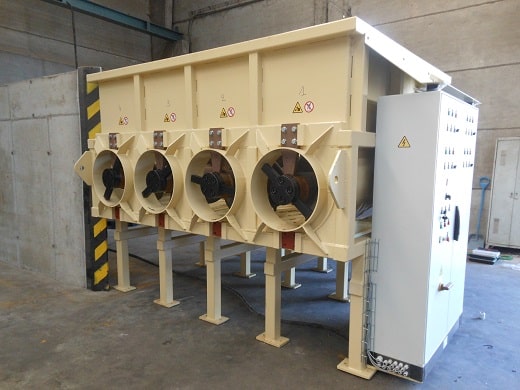
ACA crushers are 100% electric and work by force rather than impact: 15 RPM, up to 13,000 Nm of torque per shaft, moving parts that never touch, and automatic reverse on overload.
The operating speed is the reason the machine can sit inside a containment system at all. A high-speed rotor functions as a fan — it drives air through the chamber whether or not that is intended, and containment then has to fight a pressure differential the equipment itself is producing. At 15 RPM there is no such airflow to fight. The extraction system works against the dust the process creates, not against the machine.
On both streams that produces the same four outcomes:
- Volume reduction to a uniform, transportable fraction — cutting container movements, haulage cost and, for hazardous waste, consumed landfill void
- Fixings released rather than embedded, so downstream magnetic separation actually removes the steel
- Controlled particle size with low fines content, which is what makes a fraction specifiable — whether the receiver is a cement producer or a treatment process
- Indoor operation on electricity, at 75 dB at one metre when running empty, with no exhaust emissions inside the building
Hopper capacities run from 2 to 20 m³, so the machine is matched to the feed rate the facility actually receives.
The routes out
- Landfill — the current default for asbestos-containing material, and still common for asbestos-free fibre cement where no offtake route has been set up. A volume-driven cost that is rising faster than most disposal budgets assume
- Thermal or chemical treatment — processes that destroy asbestos fibre and recover the minerals are being commercialised in several European countries
- Recycling into cement — available now for asbestos-free fibre cement, subject to specification
- Reuse of whole boards — marginal, limited to undamaged modern panels with documented provenance
Routes 2 and 3 share a requirement that is rarely discussed: both need material delivered in a prepared, size-controlled, uncontaminated form. Whole corrugated sheets on a lorry are not a feedstock. That preparation step is where we work, on both streams.
Four questions this section answers
Eternit, asbestos cement or fibre cement? How to tell
What you can and cannot determine by looking, why production dates are an indicator rather than evidence, and what each answer changes about the route and the installation.
What volume costs when cement sheeting fills a container
Why the container reaches its volumetric limit at a fraction of its payload, what that costs on site and at a licensed reception facility, and how to build the number for your own operation.
Impact or force: choosing equipment for fibre-reinforced board
Why a high-speed rotor is the wrong mechanism for fibre-bearing material, why low speed is what makes containment workable, and the eight questions to put to any supplier.
What fibre cement waste must look like to have a value
Offtake and feedstock requirements in practice: composition purity, particle size distribution, the contaminants that cause rejection, and the documentation behind them.
Run your material before you decide
Send us a sample and we will process it, then tell you what the output fraction looks like, what throughput to expect, and what the installation would need to be. That includes the answer where it says your volumes do not justify a machine.
Book a test run · +45 24 82 25 82 · info@acaindustry.com
Support 24/7
We provide support 24/7, so we are always easy to get hold of. Don't hesitate to call us if you have a problem. We'll find a solution to your problem, so you can move on.
Would you like us to give you a call?