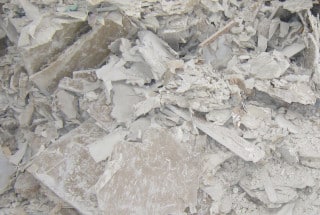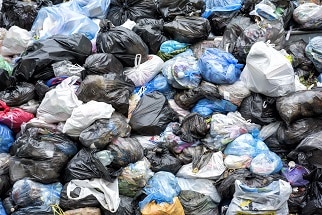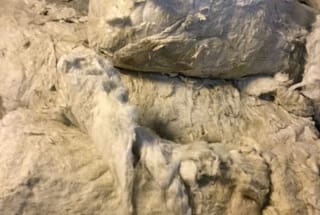
Nobody accepts whole sheets. Whether the receiver is a cement producer taking asbestos-free fibre cement as a raw material, or a treatment process taking asbestos-containing material to destroy the fibre, the requirement is the same: a prepared, size-controlled, uncontaminated feed.
That is a processing question, and it is the one this article answers — for both streams.
Asbestos-free fibre cement: a raw material with conditions
Asbestos-free fibre cement waste now has a recovery route into cement production. Industrial-scale processes operating in Europe take fibre cement waste, from production offcuts and from the construction sector, and convert it into an input for lower-carbon cement.
The material has changed category. What it has not done is become automatically acceptable.
Why receivers specify tightly
Cement production is a chemistry problem before it is a materials problem. A plant taking a secondary raw material needs to know what enters the kiln, in what proportion, with what consistency, batch after batch. A variable input is not a cheap input — it forces wider tolerances everywhere else, which costs more than the material saves.
So the phrase “crushed fibre cement” is not a specification. It describes what happened to the material, not what the material is.
Composition purity
The fraction must be fibre cement and substantially nothing else. The contaminants that cause rejection, roughly by frequency:
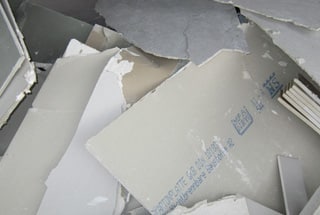
Gypsum. The most common and most damaging. Sulphate chemistry interferes directly with cement production and tolerances are low. On a mixed demolition site, plasterboard and fibre cement come down in the same week, go into adjacent containers, and end up in the same load more often than anyone admits. If you handle both materials, this is the contamination risk to design against first.
Metal. Roofing screws, nails, fixing washers, hook bolts, brackets, flashing. Every sheet leaves the building attached to something.
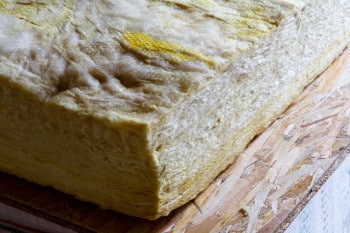
Insulation. Mineral fibre and rigid foam bonded or fixed to the rear face of composite and sandwich panels.
Bitumen and sealants. Roofing felt at laps, mastic at joints, sealant around penetrations.
Mortar, render and demolition fines — what you get when material is loaded off the ground with a grab rather than separated at source.
Organic material. Moss, soil and vegetation from long-weathered roofs. Usually minor, occasionally not.
Particle size distribution
Not “small enough” but a defined and repeatable distribution. Two properties matter.
An upper bound, because oversize material blocks feed systems and does not process predictably.
A controlled fines content, which is the property people miss. Excessive fines cause handling problems, dust issues at the receiving facility and inconsistent dosing. This is where high-speed processing quietly disqualifies material that would otherwise be acceptable: over-reduction produces exactly the fines a receiver does not want. The mechanics are in impact or force: choosing equipment for fibre-reinforced board.
Documentation
A receiver accepting construction-sector material needs provenance: which building, which period, and evidence that the material has been established as asbestos-free. Verbal assurance is not evidence. Sampling and analysis records, waste documentation and a clear chain of custody are what make the material acceptable — and what protect you if the question is raised afterwards.
This is where identification work pays for itself a second time. See eternit, asbestos cement or fibre cement?
Asbestos-containing material: a feedstock with the same problem
Treatment processes that destroy asbestos fibre and recover the minerals are being commercialised in several European countries. They are not yet everywhere, but the direction is clear, and they share a requirement with every other industrial process: they cannot be fed whole corrugated sheets.
A treatment process needs material at a controlled size, delivered at a consistent rate, so the process runs at a steady state rather than in surges. Whole sheets are a handling problem, a dosing problem and a throughput ceiling all at once.
The same applies to the facilities that receive and consolidate this material before it goes anywhere. Volume reduction inside containment reduces stored footprint, internal handling and — most significantly — the landfill void consumed per tonne where the material still goes to landfill. That arithmetic is in what volume costs when cement sheeting fills a container.
Processing on this stream happens at a licensed facility, inside containment under negative pressure with appropriate filtration, operated under the asbestos regime in that jurisdiction. The machine is built for that environment; the permission comes from the facility’s licence, not from the equipment.
The sequence that produces an acceptable fraction
Order matters, and most of the value is created in the first step rather than the last. The sequence is the same for both streams — what changes is where it happens.
- Separate at source. Fibre cement into its own container, physically apart from plasterboard, insulation and general demolition arisings. This costs nothing but discipline and prevents contamination that no downstream process can economically undo. A fraction contaminated with gypsum at source is not recoverable by better crushing
- Strip what comes off easily. Flashing, large brackets, attached insulation on composite panels. Ten minutes per panel type is worth more than any processing step later
- Controlled size reduction. Low-speed, high-torque crushing that breaks the board rather than pulverising it — releasing fixings rather than embedding them, producing a narrow size distribution rather than a spread with a long fines tail
- Magnetic separation. Effective only because step 3 released the metal. Run in the wrong order, the magnet has nothing to remove because the steel is inside the product
- Document and sample. Retain records against the receiver’s specification, and keep your own retained samples
Where ACA machines sit in that sequence
Steps 3 and 4, on both streams.
ACA crushers are 100% electric, running at 15 RPM with up to 13,000 Nm of torque per shaft. On fibre-reinforced mineral board that combination does three things that determine whether the fraction qualifies:
- It breaks rather than pulverises, keeping fines content down and the fraction inside specification
- It releases fixings, which is what makes downstream magnetic separation worth installing
- It produces a repeatable output size, which turns “we have some crushed board” into a fraction that can be written into an agreement or fed to a process at a steady rate
Operating characteristics that matter in practice: indoor operation at 75 dB at one metre when running empty, and without exhaust. Automatic reverse on overload, so a missed bracket stalls and clears rather than stopping the shift. Independently driven shafts, so one obstruction does not take the line down. Hopper capacities from 2 to 20 m³, matched to the feed rate the operation actually delivers.
Because the moving parts never contact each other, there is no progressive loss of output consistency as tooling wears. If you have contracted to supply material to a specification, that is the part of the machine specification that carries the contract. Inside a containment system it matters twice over, because every scheduled intervention is a controlled entry.
The economics, honestly
Three things move, by different amounts and with different certainty.
Disposal and void cost avoided. The largest and most certain. Material that does not go to landfill attracts no gate fee, and material that occupies less void extends capacity that cannot easily be replaced. Landfill cost is rising across European markets through taxes, bans on recoverable fractions and finite capacity.
Transport and handling cost avoided. Volume reduction cuts container movements and internal handling. On corrugated sheeting, where the container fills long before the weight limit, this is frequently the larger of the two savings.
Material revenue. Real on the asbestos-free stream, but treat it carefully. Offtake pricing for secondary raw materials is negotiated, varies by market and by distance to the receiving facility, and in some arrangements the benefit takes the form of a reduced or waived gate fee rather than a payment. Treat revenue as upside on a case that stands on the first two items alone. Any supplier building your business case primarily on material revenue is building it on the least predictable number.
There is a fourth item that never appears on the disposal invoice: a demonstrable recovery route. Under current corporate reporting regimes, diverted tonnage with documentation behind it is reportable. For contractors bidding to clients who carry their own reporting obligations, that is increasingly a line in the tender rather than a line in the sustainability report.
Before you commit to a receiver
- What exactly is the specification — composition tolerances, size distribution, maximum fines?
- What happens to a load that fails? Rejection cost, return haulage, and who carries it
- What documentation is required, and in what format?
- What volume commitment is expected, and what applies in months you do not deliver it?
- What is the all-in cost per tonne including transport, compared against the all-in cost of the alternative including haulage and void — not against the gate fee alone?
And one for yourself: can you meet the specification consistently? Material that qualifies on three loads out of four is a relationship that ends. The processing step is what makes consistency achievable, which is the reason it is worth investing in.
Frequently asked
Can fibre cement be recycled?
Asbestos-free fibre cement can be recovered as an input to cement production through industrial-scale processes now operating in Europe, provided it meets the receiver’s specification for composition purity and particle size.
Can asbestos cement be recycled?
Not in the ordinary sense. Treatment processes destroy the asbestos fibre first, after which the recovered minerals can be used. Those processes need a prepared, size-controlled feed, which is why size reduction inside a licensed facility is part of the route.
What disqualifies fibre cement waste from recycling?
Most commonly gypsum contamination, followed by metal fixings, attached insulation, bitumen and sealants, and excessive fines content from over-aggressive size reduction.
What particle size do receivers require?
There is no universal figure — each receiving facility or process specifies its own upper bound and maximum fines content. The requirement to plan against is repeatability, because that is what a specification depends on.
Find out what fraction your material produces
Send us a sample. We will process it and give you the output fraction, the particle size distribution and a throughput figure — the information you need before discussing specification with anyone.
Book a test run · +45 24 82 25 82 · info@acaindustry.com