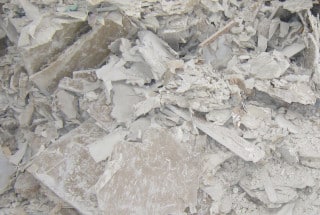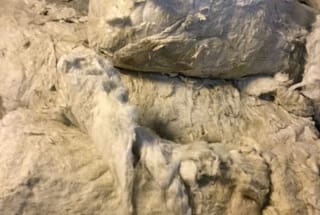
Eternit is a brand name, not a material. It tells you nothing about whether a board contains asbestos, and that ambiguity is the largest uncontrolled variable in a demolition materials budget.
Two boards off the same roof can be visually identical and be handled under entirely different regimes. Resolving which is which is a planning task, not a site task, and the projects that treat it as one are consistently cheaper to run.
The three terms, precisely
Eternit is a trademark that became a generic term across Denmark, Germany, the Netherlands and Poland for corrugated and flat cement sheeting. Boards sold under that name were made with asbestos for decades and without it for decades since. The word identifies a product format, not a composition.
Asbestos cement — also written asbestos-cement, shortened to AC sheeting, known as bonded asbestos and, in North America, as transite — is cement sheeting reinforced with asbestos fibre. It is classified as hazardous waste throughout Europe and falls under the asbestos regime in every jurisdiction.
Fibre cement (American English: fiber cement) is the post-ban material: the same manufacturing principle and product formats, reinforced with cellulose and polyvinyl alcohol fibres. It is ordinary construction waste.
ACM — asbestos-containing materials — is the regulatory umbrella covering AC sheeting alongside insulating board, pipe lagging, sprayed coatings and floor tiles. This is the term in permits and method statements.
Why the answer is a budget line
The safe default on a building of uncertain age is to assume asbestos until proven otherwise. As a safety posture that is correct. Applied to an entire quantity without testing, it is expensive in four directions simultaneously.
Disposal route. Asbestos-containing material goes to licensed facilities at hazardous waste rates. Asbestos-free fibre cement does not, and increasingly has an offtake route into cement production where it is an input rather than a liability.
Handling regime. ACM removal requires licensed contractors, controlled work areas, air monitoring, decontamination procedures and specific waste documentation. Fibre cement removal is ordinary demolition work.
Transport volume. Asbestos-containing sheets leave site intact and wrapped, which means transporting the void between corrugations at hazardous waste prices. Asbestos-free sheets can be processed at source, which changes the transport arithmetic entirely — see what volume costs when cement sheeting fills a container.
Programme. Licensed removal is slower, sequenced differently, and harder to run in parallel with other trades.
On a large industrial site with mixed-age cladding, the gap between treating everything as ACM and correctly separating the streams is one of the larger items in the demolition budget. It is determined by a decision usually made in the first fortnight.
What you can determine visually
You can identify the product format: corrugated profile, flat sheet, slate, panel, pipe. You can assess condition and weathering. Experienced surveyors read construction period from surrounding detailing.
You cannot determine fibre content by eye. Asbestos fibre in bonded sheeting is not visible to the naked eye. Boards manufactured thirty years apart can be indistinguishable in situ, particularly once weathered. Colour, surface texture, thickness and corrugation profile are weak indicators with numerous exceptions.
Manufacturer markings on the underside of boards sometimes state composition explicitly, and on modern product they often do. Where they survive they are useful. On a demolition site most do not, and their absence proves nothing.
Why construction dates are an indicator, not evidence
Checking the building’s construction or re-roofing date against the national ban is a reasonable first filter and not a defensible answer.
Ban dates differ by country. The EU-wide prohibition on asbestos took effect on 1 January 2005, but most Western European states banned it considerably earlier, and several restricted asbestos cement products specifically before restricting asbestos generally.
Three things break the date shortcut in practice:
- Stock lag. Material purchased before a ban was installed after it, sometimes years later
- Mixed-age buildings. Industrial sites are extended, patched and re-clad repeatedly. A single roof can contain boards from four decades
- Records that do not match the building. The date in the property file describes the original construction, not every board on it
Use the date to decide where to sample. Do not use it to decide what to do with the material.
The only defensible method: sample and test
Bulk sampling with laboratory analysis is the only approach producing a result you can enter on a waste consignment note and defend afterwards. It must be carried out by competent personnel under the applicable national regime.
The sampling strategy matters as much as the analysis. One sample from a roof with four construction phases tells you about one phase. Map the building by phase first, then sample each phase.
Analysis cost is negligible against the cost of being wrong in either direction. Treating ACM as ordinary waste is a regulatory and health failure with serious consequences. Treating ordinary waste as ACM is an invisible overspend that nobody is ever blamed for — which is why it persists.
What each answer changes
The result does not decide whether the material can be processed. Both streams are processed, with equipment built for the purpose. What the result decides is where the processing happens and who holds the licence.
Confirmed asbestos-containing. The material leaves site through the licensed route, intact and wrapped, and is processed at a licensed facility — inside containment, under negative pressure, with pre-filtration and HEPA-grade final filtration, operated under the asbestos regime in that jurisdiction. Size reduction at that facility is routine work, and it is where our machines are installed on this stream. What it is not is something to be done in the open on a demolition site, and no equipment specification changes that. The permission comes from the facility’s licence, never from the machine.
Confirmed asbestos-free fibre cement. The options open up at source. The material can be size-reduced on site with appropriate dust control. Fixings, nails and brackets can be separated. Volume can be cut before anything moves. The resulting fraction can go to an offtaker who wants it, provided it meets their specification — covered in what fibre cement waste must look like to have a value.
One point applies to both. Fibre cement is a fibre-reinforced mineral board in either form, and how you break it determines how much airborne dust you generate and how much fine material you lose. High-speed processing generates both, and inside a containment system it generates an airflow the containment then has to fight. That is a specification decision with real consequences, set out in impact or force: choosing equipment for fibre-reinforced board.
A working sequence for large projects
- Desk study. Construction and refurbishment dates, previous survey reports, property file, manufacturer records
- Map by construction phase, not as a single object
- Sample each phase separately — this is where most of the money is won or lost
- Split the streams physically on site as soon as results arrive, and document the separation
- Decide the route for each stream before demolition starts, including whether on-site size reduction of the asbestos-free fraction is justified at your volumes
- Retain the documentation. Offtakers require it, and so do regulators
Frequently asked
Is eternit the same as asbestos?
No. Eternit is a brand name for cement sheeting. Boards sold under that name were made with asbestos before the ban and without it afterwards. The name alone does not indicate composition.
Can you tell by looking whether a cement sheet contains asbestos?
No. Asbestos fibre in bonded cement sheeting is not visible to the naked eye, and pre- and post-ban boards can be visually identical. Laboratory analysis of a bulk sample is the only reliable method.
Is fibre cement the same as asbestos cement?
They are the same product format with different reinforcing fibre. Asbestos cement uses asbestos; modern fibre cement uses cellulose and PVA fibres. The waste classification is entirely different.
Can asbestos cement be crushed?
Yes, but only at a licensed facility, inside a containment system under negative pressure with appropriate filtration, and under the asbestos regime in that jurisdiction. It is not done in the open on a demolition site. The licence belongs to the facility, not to the equipment.
Can asbestos cement be recycled?
Not in the ordinary sense. Treatment processes destroy the asbestos fibre first, after which the recovered minerals can be used. Asbestos-free fibre cement is different — it has an established recovery route into cement production.
Whichever stream you are handling, run the material first
Send us a sample. We will process it and give you the output fraction, the particle size distribution, a throughput figure, and what the installation would need to look like for your material.
Book a test run · +45 24 82 25 82 · info@acaindustry.com